
Why Last-Click Attribution Is Costing You Money
Last-click attribution ignores 80% of the customer journey. Learn how it leads to over-investing in bottom-funnel channels and under-valuing awareness campaigns.
ONClix Team
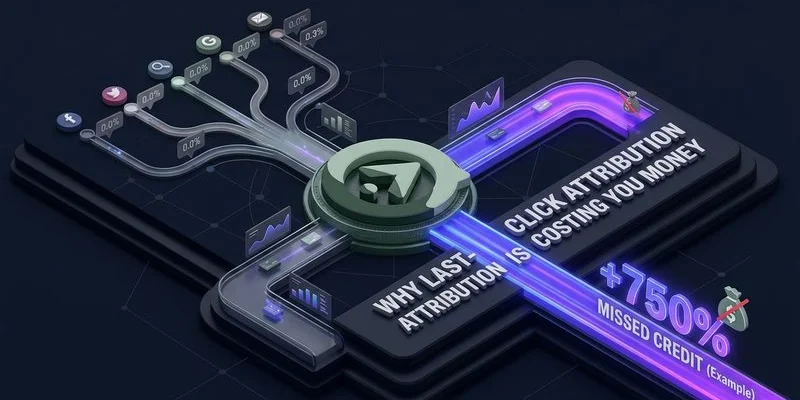
Last-click attribution is the standard reporting model for most US businesses, yet it is also the most deceptive.
This method assigns 100% of the credit for a sale to the very last thing a customer clicked.
We find that this creates a severely distorted view of performance.
It leads business owners to over-invest in bottom-funnel ads while slowly starving the awareness campaigns that actually generate the customers.
If you rely on this model to approve budgets, you are likely misallocating capital. Switching to proper marketing attribution software reveals the full picture and stops the bleeding.
We frequently audit accounts where teams waste nearly half of their budget because their data tells the wrong story.
The core issue is straightforward.
Modern buying paths are complex, but most reporting tools still act like it is 2015.
You know how a basketball box score credits the player who makes the shot but ignores the two crucial passes that created the opening?
We refer to this as the “Last-Click Illusion.”
This dynamic effectively dismantles growth strategies across the country.
The model shows you who captured the demand, not who created it.
Our team is going to break down why this fails in the current privacy environment and explain the three-layer “attribution stack” successful brands use today.
The Core Problem With Last-Click
B2B and high-ticket B2C buying journeys are longer than ever.
Recent data from Forrester indicates that the average buying group now engages in 27 distinct interactions before signing a contract.
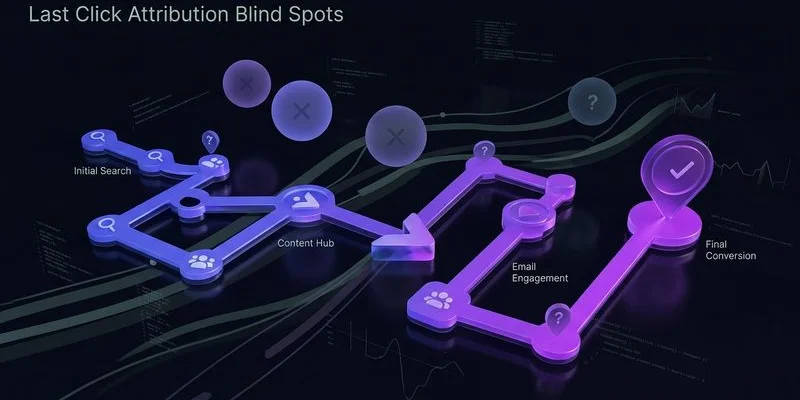
A potential client might take a winding path like this:
- See a LinkedIn post from your founder.
- Read a comparison review on G2.
- Listen to a podcast interview while commuting.
- Click a retargeting banner three weeks later.
- Search for your company name on Google to finally buy.
Last-click attribution gives that final Google search 100% of the glory.
The LinkedIn post, the review, the podcast, and the banner ad get zero credit.
We equate this to firing your top salespeople because they didn’t physically sign the contract, even though they did all the persuasion.
Every ignored touchpoint is a lost clue about what drives your revenue.
Our audits consistently show businesses pausing their most effective YouTube or display campaigns because the “last click” didn’t happen there.
This creates a marketing engine that can harvest existing demand but cannot grow.
Real-World Budget Misallocation
Relying on this flawed data leads to three specific, expensive mistakes in your budget.
Branded Search Gets Over-Credited
Branded search campaigns bid on your own company name.
These ads almost always appear as the final step before a purchase.
We encourage you to consider what had to happen for a user to type your specific name into a search bar.
They had to learn about you previously.
Last-click models ignore the radio spot, the Facebook ad, or the referral that built that awareness.
A well-known 2013 study by eBay found that pausing branded search for their own name resulted in almost no loss of sales.
This proved high cannibalization, yet many businesses still fall for this trap in 2026.
Teams see a high Return on Ad Spend (ROAS) here, so they increase the budget.
The result is a pipeline that shrinks over time because no money is going toward finding new people.
Retargeting Looks Like a Hero
Retargeting follows visitors who left your site and shows them ads to bring them back.
This is inherently a bottom-funnel tactic targeting people who already know you.
We see retargeting campaigns claiming credit for conversions that would have occurred naturally.
Lift tests often reveal that these ads add far less incremental value than the dashboard claims.
Consider a user who is comparison shopping, checks a competitor, and clicks your retargeting ad just to return to your site to finish the purchase they already planned.
The ad platform claims the sale.
Content Marketing Gets Killed
Blogs, educational videos, and podcasts introduce people to your brand.
These touchpoints are usually the first step, not the last.
We find that content marketing appears to have a negative ROI in last-click reports.
This leads directly to budget cuts for content teams.
High-quality SEO content often has a maturation period of 5 to 7 months before it drives significant volume.
The irony is that this content starts the relationships that eventually close through the channels last-click favors.
Cut the content, and you cut off the supply of new leads.
What the Full Customer Journey Actually Looks Like
Tracking the complete path reveals a completely different reality.
We have broken down a typical SaaS attribution comparison below to show the discrepancy.
| Channel | Last-Click Credit | Multi-Touch Reality | The Difference |
|---|---|---|---|
| Branded Search | 60% | 15% | Overvalued by 4x |
| Retargeting | 25% | 15% | Overvalued by 60% |
| Organic Content | 5% | 30% | Undervalued by 6x |
| Paid Social | 5% | 20% | Undervalued by 4x |
We also have to account for the “Dark Funnel.”
These are the conversations in private Slack communities, text threads, and offline word-of-mouth that software cannot track.
Vault GTM Research recently found a 90% gap between attribution software data and what customers say in “How did you hear about us?” surveys.
The multi-touch view proves that organic content and paid social are doing the heavy lifting.

The Feedback Loop That Makes Things Worse
Last-click attribution triggers a cycle that harms performance over time.
- Data Distortion: Last-click reports show bottom-funnel channels have the best ROI.
- Budget Shift: You move money away from awareness and into search/retargeting.
- Pipeline Decay: Fewer new people enter the top of the funnel.
- Volume Drop: Total sales decline across all channels.
- False Validation: The remaining sales are still attributed to the bottom funnel.
- Double Down: The team cuts awareness spend again to “fix” the efficiency.
- Stagnation: Growth flatlines completely.
We call this the “Performance Plateau.”
It typically takes two fiscal quarters for the damage to become visible in your bank account.
Privacy changes in 2026, including Apple’s Link Tracking Protection in Mail and Messages, make this harder by stripping the parameters that connect these dots.
By the time you notice the drop, you have lost months of potential lead generation.
The 2026 Attribution Stack
You do not need to replace your entire analytics setup to fix this.
We recommend a modern “stack” approach that layers three specific methodologies.
1. The Technical Foundation: Server-Side Tracking
Browser-based pixels now lose up to 30% of data due to ad blockers and iOS privacy settings.
You cannot optimize for revenue you cannot see.
We advise implementing Server-Side Tracking (like Meta CAPI or Google Enhanced Conversions) immediately.
This technology sends data from your server to the ad platform, bypassing browser restrictions.
Your data match rates will likely improve by 15-20% within the first month.
2. The Validator: Incrementality Testing
Models are estimates, but experiments provide proof.
The only way to know the true value of a channel is to turn it off and see what happens.
We use “geo-lift” studies where we stop ad spend in a specific state (like Ohio) and compare sales against a control state (like Pennsylvania).
This answers the question, “Would these people have bought anyway?”
Platforms like Haus or the native “Experiments” tab in Google Ads make this accessible for mid-sized businesses.
3. The Strategist: Marketing Mix Modeling (MMM)
Marketing Mix Modeling is the standard for 2026 because it does not require cookies.
We are seeing a 46% increase in marketers adopting MMM this year.
This method uses statistical regression to look at spending spikes and revenue spikes over time to find correlations.
Tools like Recast or Measured bring this power to brands that don’t have data science teams.
The Bottom Line
Last-click attribution is actively harmful to your financial performance.
It forces you to invest in channels that close deals while neglecting the ones that bring you customers.
We know that the longer you rely on it, the more your market share shrinks.
Moving to a multi-touch attribution or MMM-based model is a high-leverage change that often reveals your “worst” channels are actually your biggest growth drivers.